Introduction
Many people believe that weight gain is simply the result of eating too much and exercising too little.
While nutrition and physical activity remain fundamental, they are only part of the story.
As we age, our bodies undergo significant hormonal and metabolic changes that can make maintaining a healthy weight increasingly challenging. Three of the most influential factors are insulin regulation, cortisol (the stress hormone), and estrogen balance.
These are often referred to as metabolic blockers because, when they become dysregulated, they can contribute to increased fat storage, reduced energy levels, poor sleep, cravings, and difficulty losing weight despite making healthy lifestyle choices.
Fortunately, advances in metabolic medicine and peptide therapy are providing new ways to support these biological systems alongside proper nutrition, exercise, and healthy lifestyle habits.
The Three Major Metabolic Blockers
- Insulin – Your Body’s Energy Storage Hormone
What is insulin?
Insulin is a hormone produced by the pancreas.
Its primary role is to move glucose (blood sugar) from the bloodstream into cells where it can be used for energy.
Without insulin, glucose cannot efficiently enter cells.
What happens as we get older?
As we age, many people gradually develop insulin resistance.
This means the body’s cells become less responsive to insulin, forcing the pancreas to produce more insulin to achieve the same effect.
Persistently elevated insulin levels can promote:
- Increased fat storage
- More abdominal fat
- Increased hunger
- Reduced fat burning
- Energy crashes
- Increased risk of Type 2 Diabetes
This process often develops slowly over many years.
Common symptoms
- Constant hunger
- Sugar cravings
- Afternoon fatigue
- Difficulty losing weight
- Weight gain around the waist
- Elevated blood sugar
- Cortisol – The Stress Hormone
What is cortisol?
Cortisol is produced by the adrenal glands.
It is essential for:
- Managing stress
- Regulating blood pressure
- Controlling inflammation
- Maintaining blood sugar
- Supporting normal metabolism
Cortisol itself is not harmful.
The problem occurs when cortisol remains elevated for prolonged periods.
What raises cortisol?
- Chronic stress
- Poor sleep
- Overtraining
- Illness
- Anxiety
- Depression
- Shift work
- Sleep deprivation
Effects of chronically elevated cortisol
- Increased appetite
- Sugar cravings
- Fat storage around the abdomen
- Reduced muscle recovery
- Fatigue
- Difficulty sleeping
- Elevated blood glucose
Poor sleep and high cortisol often reinforce one another, creating a cycle that can be difficult to break.
- Estrogen – More Than a Reproductive Hormone
What is estrogen?
Estrogen plays important roles in:
- Fat distribution
- Bone health
- Muscle maintenance
- Brain function
- Heart health
- Insulin sensitivity
What changes with age?
During perimenopause and menopause, estrogen levels fluctuate and eventually decline.
These hormonal changes can contribute to:
- Increased abdominal fat
- Reduced muscle mass
- Lower metabolic rate
- Reduced insulin sensitivity
- Poor sleep
- Hot flushes
- Mood changes
It is important to understand that estrogen itself does not directly cause weight gain, but changes in estrogen influence how the body stores and uses energy.
How These Three Metabolic Blockers Work Together
Metabolic Blocker | Common Effects |
High Insulin | Fat storage, cravings, reduced fat burning |
High Cortisol | Stress eating, poor sleep, abdominal fat |
Estrogen Changes | Slower metabolism, altered fat distribution, reduced muscle mass |
Together they create a cycle where losing weight becomes progressively more difficult.
Can Peptides Help?
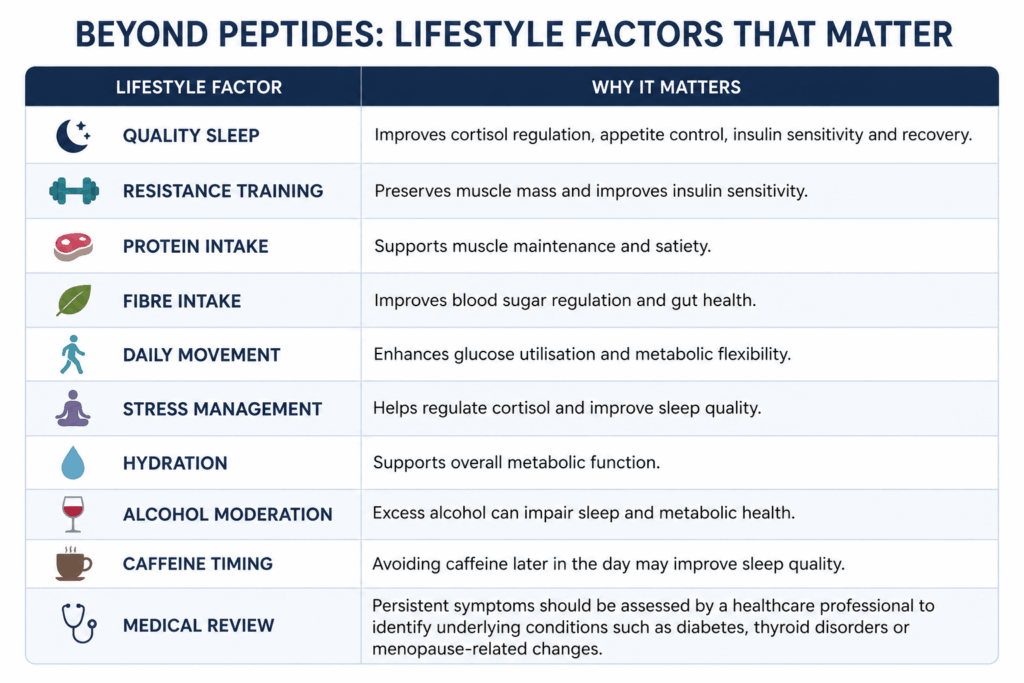
Peptides should never be viewed as a replacement for healthy lifestyle habits.
However, certain peptides may support specific metabolic pathways.
The strength of evidence varies considerably between products.



 Appetite regulation